
Can Relationship Workbooks For Couples Actually Help? Eight Self-Paced Guides From a Couples Therapist

By Dr. Valinda Harlan, PsyD, LMHC, LPC, NCC | Bright Future Counseling, Vancouver, WA

Key Takeaways
A relationship workbook is not a replacement for therapy. It can give you structure, shared language, and a way to practice, either before you start counseling or between sessions.
I created eight self-paced digital workbooks that draw on the Gottman Method, Emotionally Focused Therapy (EFT), and attachment research.
Start with the one workbook that matches your biggest concern right now. Finishing one is worth more than starting five.
If there is abuse, coercive control, or a crisis, a workbook is not the right first step. Professional support comes first.
Most couples I meet have been trying to fix things on their own for a long time. They have read the articles, listened to the podcasts, and had the same conversation in the car, at the kitchen table, and at eleven o'clock at night. Many of them tell me they did not know what to try next, or that they were not quite ready for therapy.
That gap is a big reason I turned the exercises I use with clients into workbooks. I wanted people to have something practical to work with at home, written by someone who sits with couples every week and knows where they tend to get stuck.
This post covers what a workbook can and cannot do, how to use one well with a partner, and a plain-language look at each of the eight I have written.
Can a Relationship Workbook For Couples Help?
The honest answer is that it depends on what you ask it to do.
A good workbook can help you slow down, put words to what is happening, practice a new way of talking, and keep a hard conversation from wandering off track. What it cannot do is assess your safety, notice what you are missing, or respond to you in the moment the way a therapist can.
In my experience, workbooks help most when:
Both partners are willing to try, even if one is more hopeful than the other.
The problem is a repeating pattern, such as the same argument or a slow drift apart, rather than an emergency.
You want to practice new skills, not just talk about them.
You are already in counseling and want something to work on between sessions.
You are on a waiting list, thinking about therapy, or not sure you are ready to start.
They help least when one person is afraid of the other, when there is active addiction, or when a recent betrayal has left one or both of you in crisis. I come back to that near the end of this post.
What Is Behind the Workbooks?
The series is rooted in the Gottman Method and Emotionally Focused Therapy, two of the best-researched approaches in couples counseling. A recent meta-analysis of emotionally focused couple therapy found it to be an effective treatment for relationship distress (Levine et al., 2024), and the Gottman approach has decades of research behind it.
I built the series around three goals:
Clearer communication. Interrupting the attack-and-defend cycle and learning practical ways to say what you need.
Healing and repairing trust. Working through the aftermath of broken trust at a steady, safe pace.
Deepening intimacy. Reconnecting emotionally and sexually.
Each relationship workbook for couples is self-paced, printable, and written in plain language. I kept the jargon out and the exercises short, because most of the couples I work with are busy and tired.
How to Use a Workbook With Your Partner
Pick one workbook and one goal. Talk about what you most want to change, then choose the workbook that fits.
Put it on the calendar. Choose a regular time when you are both rested and away from screens and kids. Short, regular sessions usually work better than one long, exhausting one.
Do your own answers first. Fill out your pages on your own before you compare. It keeps you from shaping your answers around what your partner wrote.
Agree on a pause signal. When your heart is racing and you cannot listen, you are flooded. The Gottman Institute recommends taking at least 20 minutes to calm down before returning to the conversation. Say so out loud, and then actually come back to it.
Listen to understand, not to win. Your partner's answers are information about their experience. They are not evidence for your case.
Revisit it. Look back at finished pages after a few weeks. Progress is easier to see than it is to feel.
The Eight Workbooks
All eight are available as downloadable ebooks in my Etsy shop, RelationshipTool, in paperback, and on Kindle as the Relationship Guided Workbooks Series by Dr Valinda Harlan on Amazon

A couple's guide to improve understanding and intimacy
If you keep having the same argument with different details, start here. Gottman's research describes four patterns that wear relationships down: criticism, contempt, defensiveness, and stonewalling. Most couples recognize at least one of them right away. This workbook is about understanding what is happening underneath your conflicts and practicing clearer ways to ask for what you need and to hear your partner when they do the same.

A couple's path to greater security and connection
Adult attachment research, which took off with Hazan and Shaver's 1987 work on romantic love, suggests that the way we learned to seek closeness early in life shapes how we handle it as adults. Some of us pursue when we feel distant. Some of us withdraw. Many of us do both, depending on the day. This workbook helps you and your partner recognize your own tendencies and each other's without turning them into labels or excuses. Attachment patterns can shift, and understanding them is often the first step.

Not every hard relationship is hard in the same way. Ordinary friction, unhealthy patterns, and harmful behavior call for very different responses. This workbook helps you sort out what you are experiencing so you can respond to it accurately.
A note on safety: if reading this leaves you afraid of your partner, or you recognize abuse or coercive control, contact the National Domestic Violence Hotline at 1-800-799-7233, by texting START to 88788, and at thehotline.org.

A guide for betrayal recovery
After infidelity or another serious breach of trust, the questions come fast and the emotions come faster. Research on affair recovery, including work by Gordon, Baucom, and Snyder (2004), describes a general path: dealing with the impact of the betrayal, making sense of how it happened, and then moving forward. This workbook offers step-by-step structure for that process. It is not a shortcut, because trust is rebuilt through consistent behavior over time. But a framework can keep you from feeling lost. If the betrayal is recent and overwhelming, I encourage you to pair the workbook with counseling or a weekend intensive.
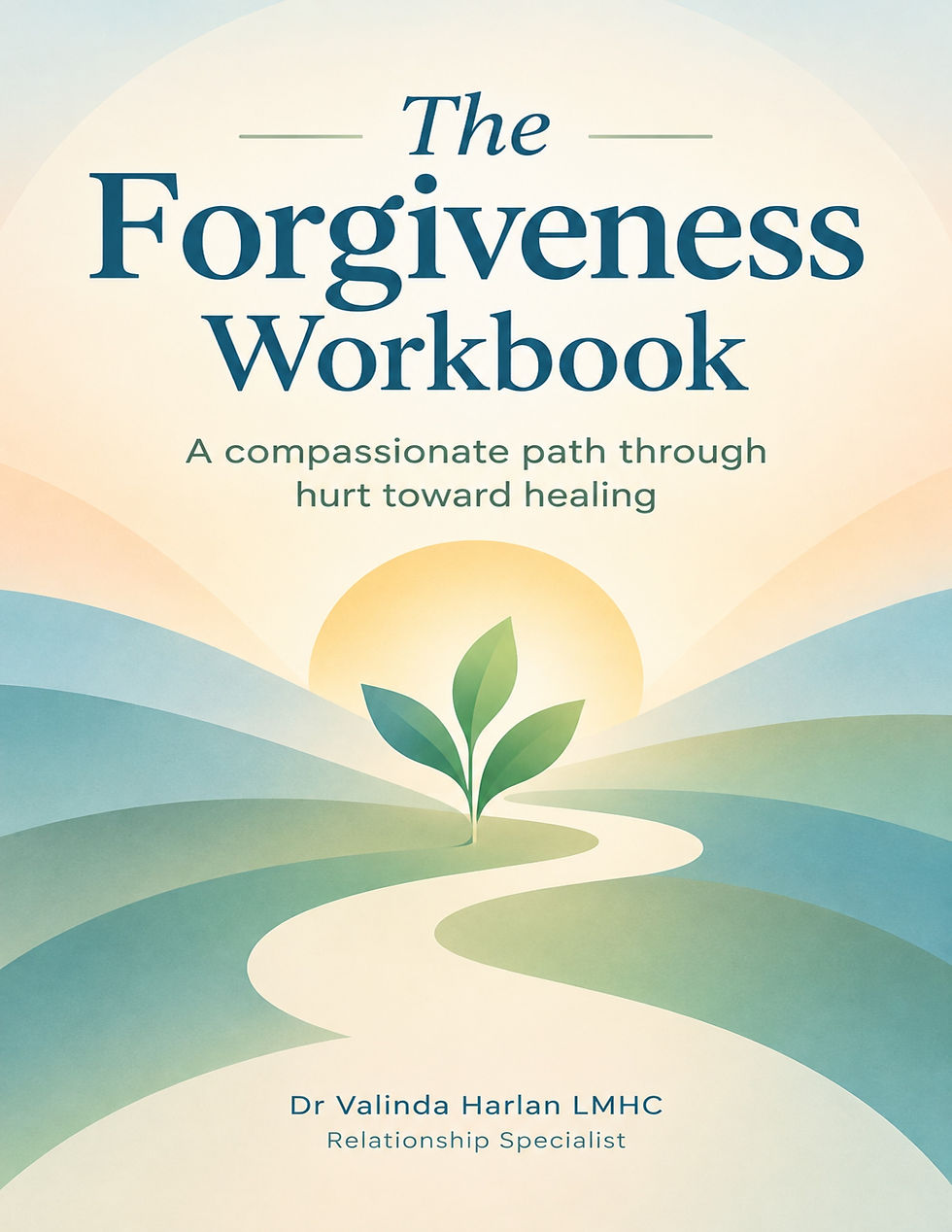
A compassionate path through hurt toward healing
Forgiveness gets misunderstood. It does not mean excusing what happened, forgetting it, or staying in the relationship. It is a process of loosening the grip the hurt has on you. A meta-analysis of forgiveness interventions (Wade et al., 2014) found that structured approaches can help people forgive, and that more time spent in the process tended to produce stronger results. Forgiveness work is personal, so this workbook can be useful even if your partner is not ready to join you.

A guided path to healthier relationships and boundaries
Codependency is not a formal diagnosis, but it describes something real: taking responsibility for other people's feelings and choices, struggling to say no, and losing track of your own needs. Many people who live this way are kind, capable, and exhausted. This workbook focuses on boundaries and the habits that keep these patterns going, with the goal of relationships that feel more balanced.

Sexual connection is one of the hardest topics for couples to raise, partly because both people tend to feel rejected, pressured, or embarrassed. This workbook is for couples who want a structured, low-pressure way to talk about desire, differences in sex drive, and rebuilding closeness. For more background, see my posts on improving sexual intimacy and different sex drives and low libido.

A couple's guide to renewed connection and meaning later in life
Retirement, an empty nest, menopause, health changes, and the loss of old routines can all reshape a long relationship. Couples often tell me they love each other but no longer know what they are building together. This workbook is written for that stage of life, with a focus on renewed connection and shared meaning. My post on menopause and relationships covers related ground.
Which Workbook Should You Start With?
Having the same argument again and again: Communication and Connection
Feeling like roommates, or pulling apart without knowing why: Understanding Attachment Styles
Not sure whether what is happening is normal: Understanding Relationship Patterns
Recovering from an affair or broken trust: Repairing Trust, ideally with professional support
Carrying a hurt you cannot set down: The Forgiveness Workbook
Taking care of everyone else and losing yourself: Breaking Codependent Patterns
Emotional or sexual distance, or mismatched desire: Deepening Sexual Intimacy
Facing a major life transition later in life: Love Through Life's Changes
When a Workbook Is Not Enough
Please reach out to a professional first, or alongside the relationship workbooks for couples, if:
You feel afraid of your partner, or there is physical violence, threats, or controlling behavior.
Substance use is actively harming the relationship.
A betrayal was discovered recently and one or both of you feel overwhelmed.
You have been stuck in the same place for months despite real effort.
You are having thoughts of harming yourself. In the US, you can call or text 988 at any time.
At Bright Future Counseling, I work with couples and individuals in person in Vancouver, Washington and by telehealth throughout Washington and Oregon, and I offer relationship coaching for people outside those states. If you want more concentrated time together, I also offer weekend intensives. You can call or text me at 360-831-2345 or book a session online.
Frequently Asked Questions About Relationship Workbooks For Couples
Can a couples workbook replace therapy?
No. A workbook is a structured way to start or to practice between sessions. If you are dealing with abuse, active addiction, an affair discovered very recently, or thoughts of harming yourself, please contact a professional first.
Do both partners need to complete the workbook?
It works best when both partners are willing, since most of these are written for couples. Some, such as The Forgiveness Workbook and Breaking Codependent Patterns, can also be worked through on your own. Some people start by themselves and invite their partner in later.
Which workbook should I start with?
Choose the one that matches the problem you most want to change. Communication and Connection is a good general starting point. If there has been a betrayal, start with Repairing Trust and consider adding counseling.
How do I get the workbooks?
They are digital downloads from my Etsy shop. Your files are available as soon as Etsy confirms your payment, and you can print them or work on a screen.
What if the exercises bring up hard feelings?
That is common. Pause, take a break of at least 20 minutes, and come back when you both feel calmer. If conversations keep escalating or the feelings feel too big, that is a good sign it is time to add support from a therapist.
Can I bring a completed workbook to therapy?
Yes. Bring it to a session if you are working with me or another therapist. Completed pages give us a head start on what matters most to you.
The Bottom Line
A workbook will not fix a relationship on its own. What it can do is give two people a shared, structured way to start talking differently, and it can give one person a place to start when their partner is not ready yet. Choose one that fits where you are, go at a pace you can keep up, and ask for professional help when you need more than pages can give.
All eight are available as downloadable ebooks in my Etsy shop, RelationshipTool, in paperback, and on Kindle as the Relationship Guided Workbooks Series by Dr Valinda Harlan on Amazon
Or contact me if you would like to talk about counseling.
